On This Page
Informed by Data
Multi-year formative and summative evaluations by Arizona State University found that participation in Citizen Science Month benefits participants, project scientists, and facilitators—including increased understanding of citizen science and greater confidence to engage in projects.
Evaluation Highlights
Citizen Science Month 2024 Summative Evaluation
Citizen Science Month Across the Years: 2025 Poster, Association for the Advancement of Participatory Sciences
2.50 Million Acts of Science Badge!
Learn how to earn a digital badge for your participation in 2.50 Million Acts of Science!

The History of Citizen Science Month
Citizen Science Month began in 2019 as Citizen Science Day and expanded into a month-long initiative in 2020. Over time, the initiative has grown in geographic reach, strengthened partner engagement, and added training and resources to support both participants and facilitators.
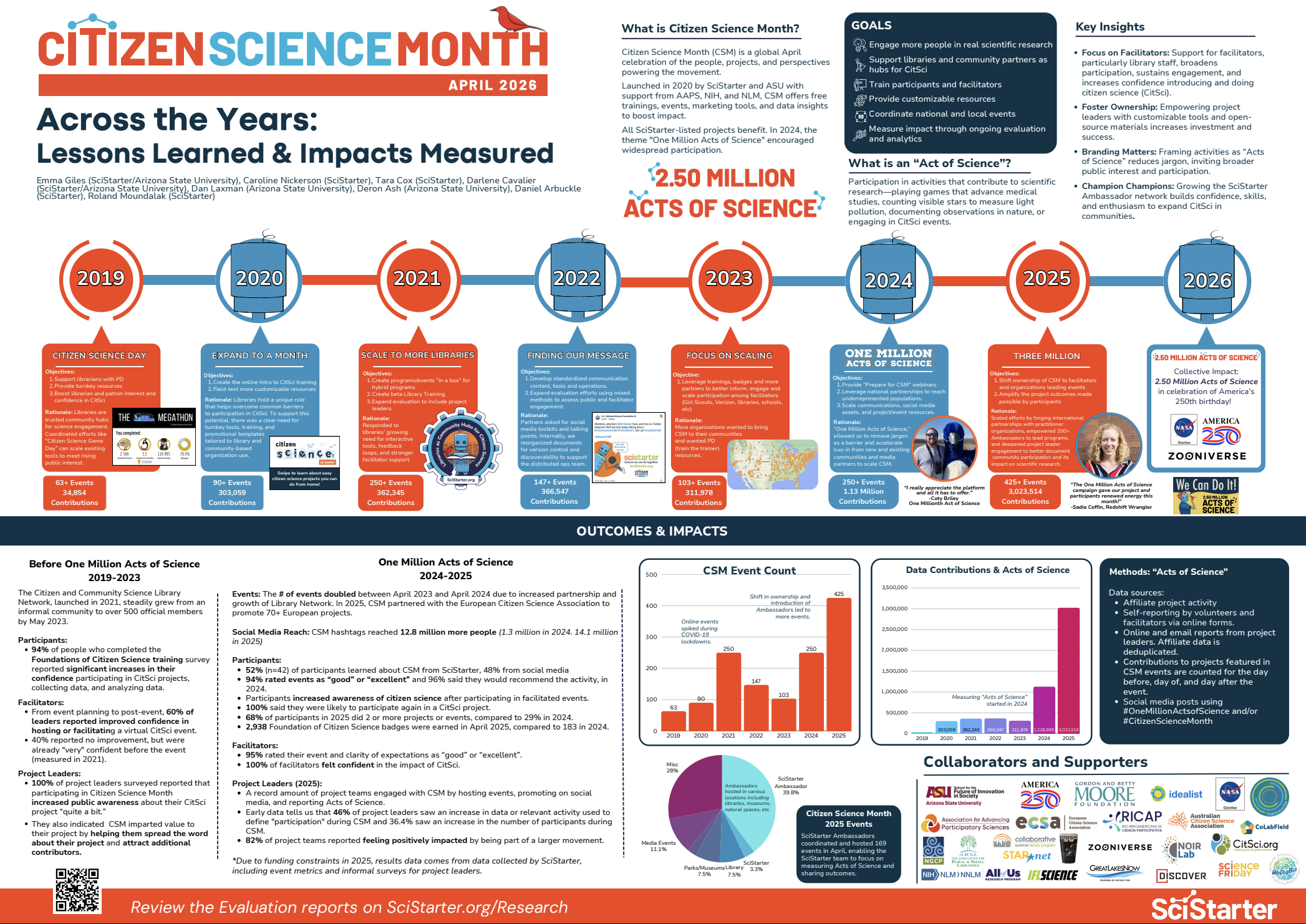
Giles, E., Et al. Citizen Science Month Across the Years: Lessons Learned & Impacts Measured. ECSA Conference 2026.
WHAT WE’VE LEARNED OVER THE YEARS
Since expanding to a full month, the program has evolved through continuous improvement and evaluation—including foundational training for citizen scientists and facilitators, global collaboration, and expanded community hubs (including libraries) that support participation worldwide. Learn more about what we achieved together during Citizen Science Month 2025 and see the most recent results from Citizen Science 2026 on the SciStarter Blog!
Citizen Science Month 2025 Highlights Reel
Founding Partners
SciStarter.org
SciStarter brings together people, projects, and tools to make large-scale public participation in science possible. It connects millions of curious and concerned individuals with thousands of opportunities to participate in real scientific research, offering volunteer pathways that match people’s interests, time, goals, and availability. This shared ecosystem accelerates scientific research and delivers meaningful benefits for society.
Arizona State University
The School for the Future of Innovation in Society (SFIS) is a transdisciplinary unit at the vanguard of ASU’s commitment to linking innovation to public value. SFIS pursues a vision of responsible innovation that anticipates challenges and opportunities, integrates diverse knowledge and perspectives, and engages broad audiences. By examining the ways we translate imagination into innovation — and how we blend technical and social concerns along the way — SFIS aims to build a future for everyone. ASU’s University Office of Evaluation and Educational Effectiveness (UOEEE) & College Research and Evaluation Services Team (CREST) has supplied research and evaluation support across the years.
Association for the Advancement of Participatory Sciences
The Association for Advancing Participatory Sciences (AAPS) is a member-driven organization that connects people from a wide range of experiences around one shared purpose: advancing knowledge through research and monitoring done by, for, and with members of the public. The association was a founding partner supporting the growth and coordination of the participatory sciences field.
Financial and Partnership Support
Thanks to support over the years from the National Institutes of Health, the National Library of Medicine, and the Gordon and Betty Moore Foundation, SciStarter and Arizona State University have scaled the program globally, supported a network of more than 1,000 public libraries, and increased the public’s awareness of and engagement in scientific research.
Frequently Asked Questions
Citizen science (also called participatory research or community science) takes place year-round. Each April, Citizen Science Month spotlights discoveries, volunteers, practitioners, projects, and outcomes—and makes it easier for people to join together in shared activities.
Scientists can’t be everywhere and they don’t know everything. That’s why they need you. By following simple protocols, such as documenting observations or classifying images, you can jump in and help answer questions scientists cannot answer without you. Every project is different, and everyone is invited to participate.
Visit the Citizen Science Month resources page to explore toolkits, planning guides, and outreach materials. Use our Media Toolkit to spread the word!
Citizen Science Month is the umbrella term for all events and programs taking place in April.
Acts of Science: this is a call to action and one way to digitally measure impact. How many data observations were shared? How many online data files were annotated or analyzed? SciStarter records these Acts through Affiliate projects (these projects uses digital tools that report data to SciStarter) and self reporting through online forms hosted by SciStarter. In April 2026, the goal is 2.50 Million Acts of Science in celebration of America’s 250th birthday.
Acts of Science: Connected: This refers to a series of weekly, virtual events hosted by SciStarter that feature a single project. Anyone can tune in from wherever they are, as we all do the same project together. We’ll introduce you to the project scientist who will talk us through the steps and answer your questions.
Many libraries, schools, museums, etc, will host in-person gatherings and livestream these virtual events. Attendees will bring their computers. Hosts will stream the virtual event, and provide Wi-Fi, space, swag, and fun and people around the world engage in the same project, at the same time.
Find a list of weekly events and featured projects here.
We’d love to hear from you! Email info@SciStarter.org. Also consider reaching out to a nearby SciStarter Ambassador.
Presented By:

Promotional and Community Engagement Support provided by: