PROJECT
Wicked Words
Reading Challenges in Everyday Life
Overview
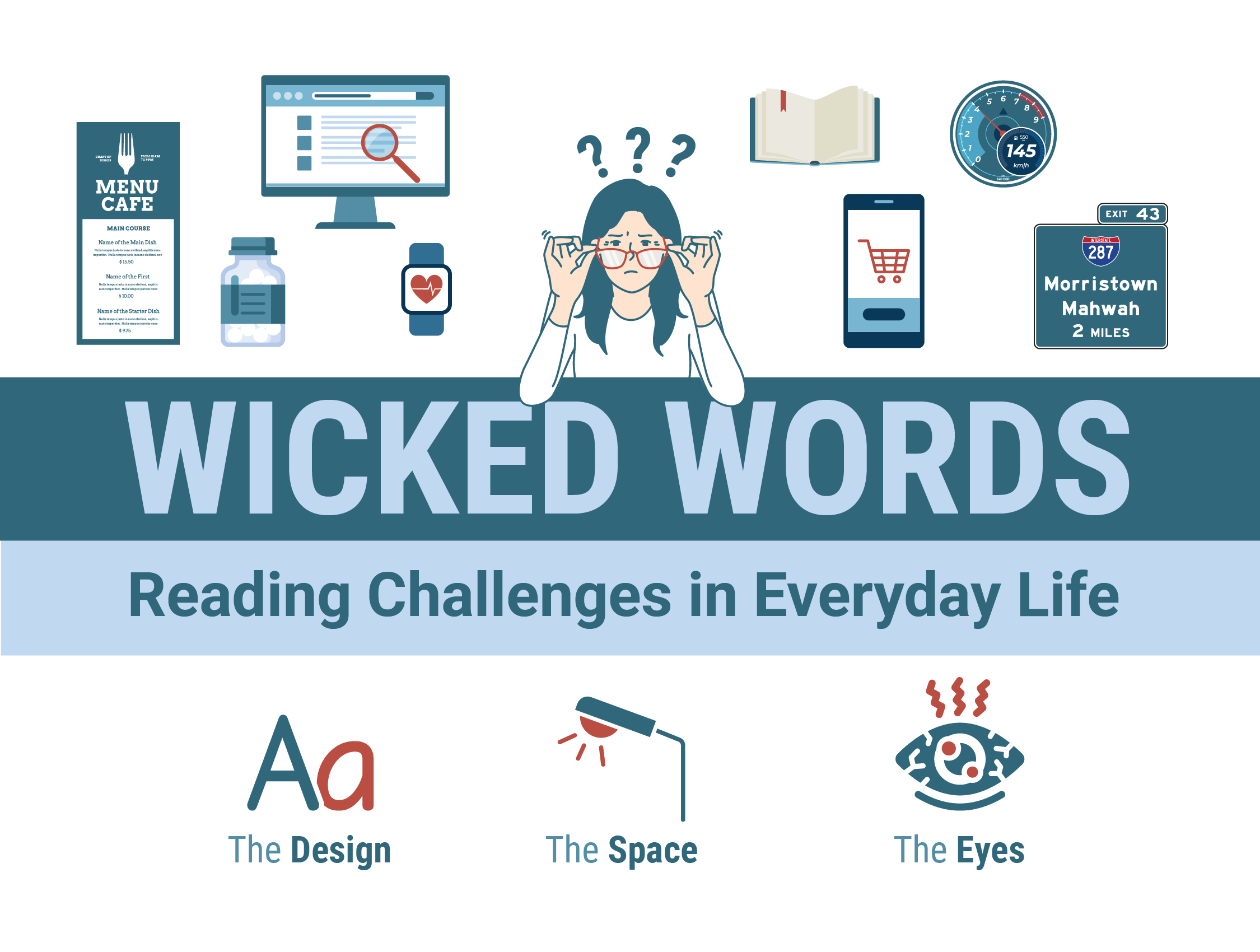
Reading is something we do constantly, yet each reading experience can feel very different. Some text feels clear and effortless, while other text is frustrating, tiring, or surprisingly hard to read. These differences often depend on where we are, what we’re reading, the lighting around us, and the devices we use.
Wicked Words invites people to contribute examples of text they encounter in their everyday lives. If you have a smartphone, a few minutes of time, and curiosity about how reading works, you can take part.
You contribute by documenting text you naturally encounter during daily life, on a phone, a screen, a page, a label, or a sign, and answering a few short questions about your reading experience. Each contribution takes only a few minutes, and you can choose how many examples to share.
Materials Needed
Steps
Materials Needed
- Mini-Screen Monday
Text displayed on a small screen (e.g., smartphone, smartwatch, etc.) that is difficult to read. - Terrible Tuesday
Text that is terribly formatted, making it hard to read. - Wonderful Wednesday
Any reading experience that feels easy and pleasant to read. - (Twi)light Thursday
Difficulty in reading due to lighting conditions (e.g., glare, low light, twilight). - Focus Friday
Text that becomes difficult to read during prolonged reading or when sustained focus is required (at least 30 minutes).
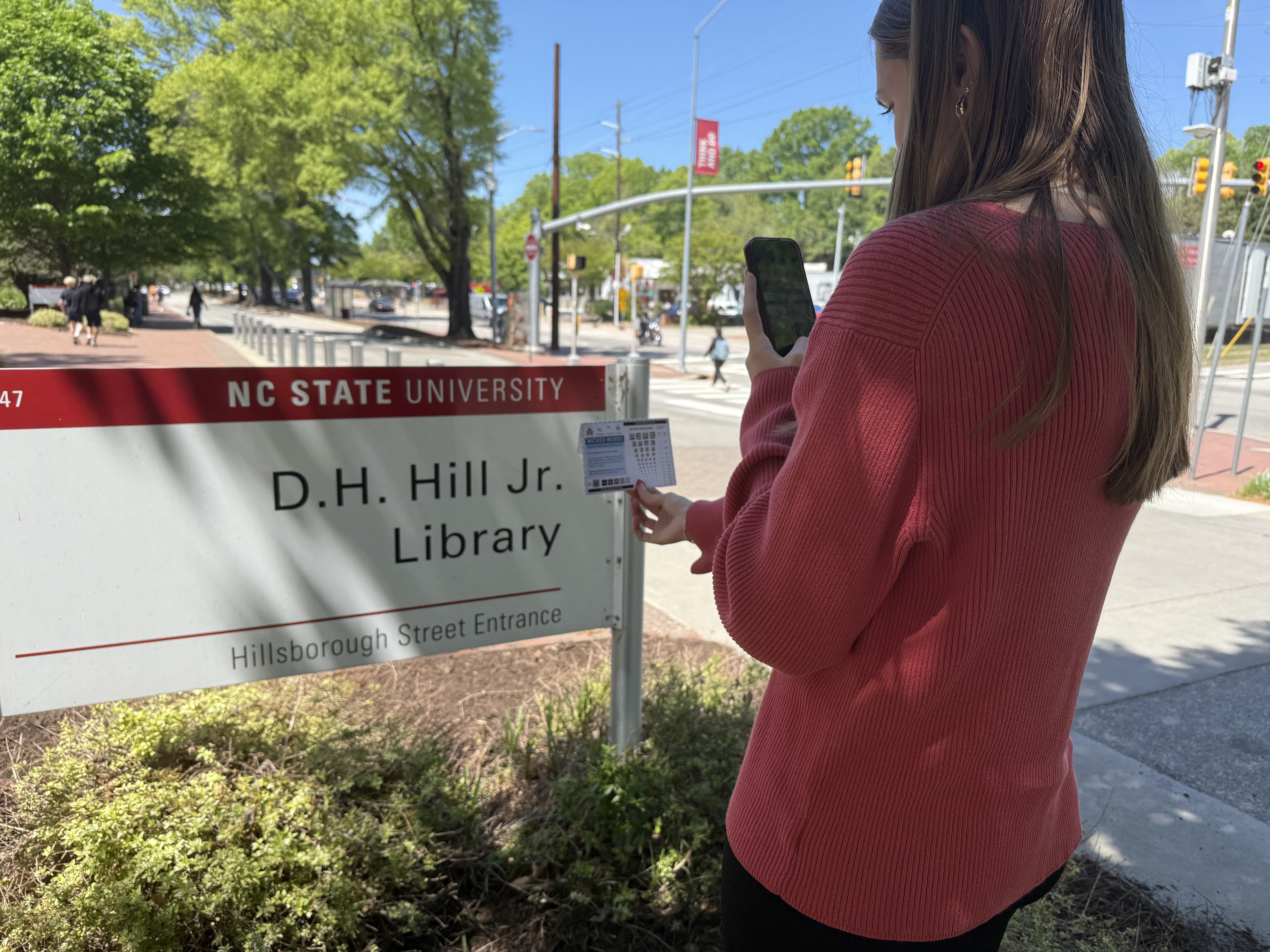
Hold the reference card at arm’s length when taking the photo.
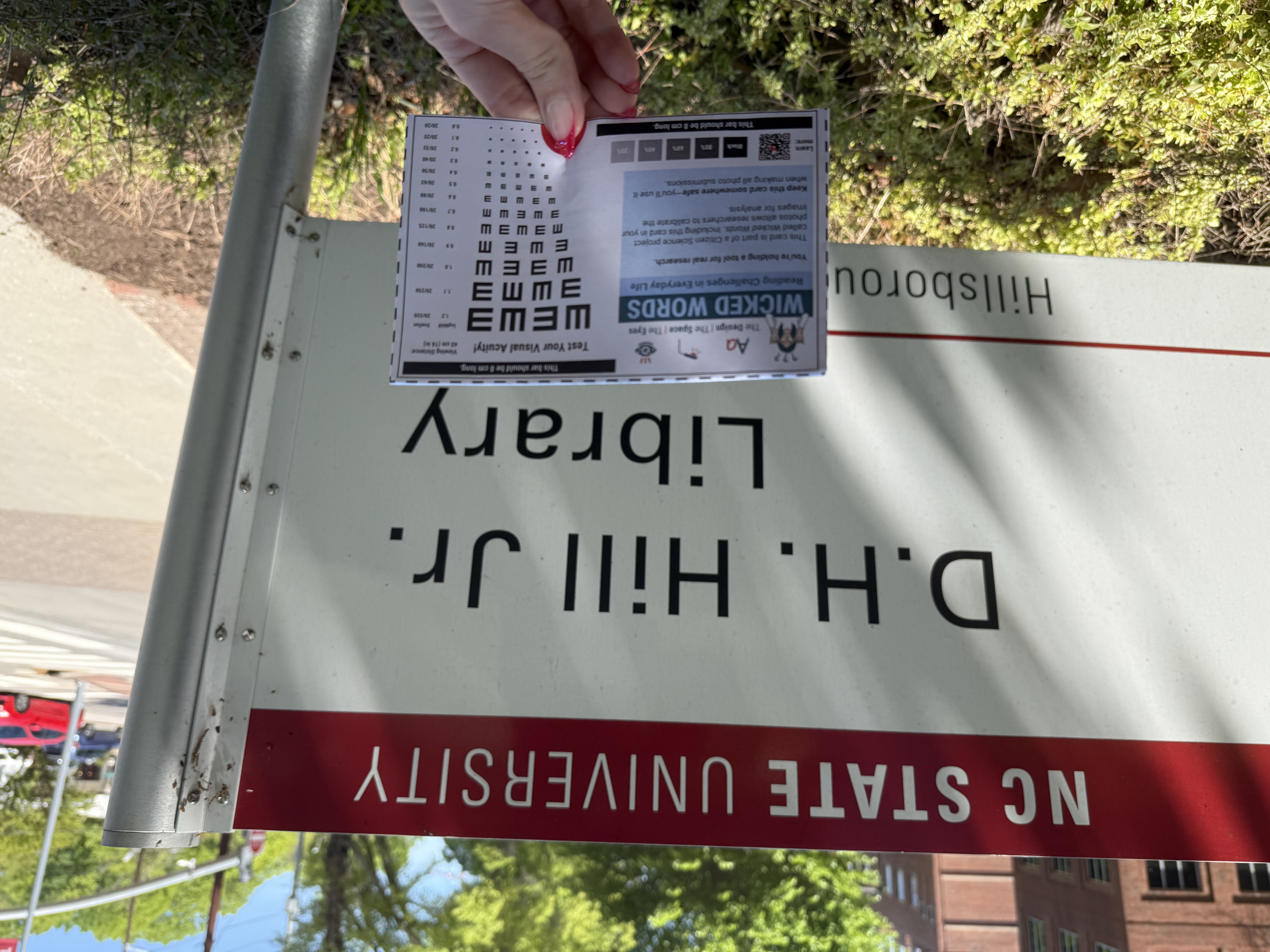
This is an example of the sample text with the reference card.
Goals of the Project
By collecting real-world examples, this project aims to:
Frequently Asked Questions
Everyone who is interested in helping with this research is welcome to participate!
Participants contribute by taking photos of text they encounter in everyday environments and submitting them through a short online survey.
When submitting a photo, participants also answer a few brief questions about their reading experience. These responses help researchers understand how different conditions influence readability in real-world situations.
Each submission typically takes only a few minutes to complete and you can participate as many times as you would like.
See all steps on the Overview tab.
You may photograph many types of text that you encounter in your daily life, including:
• Text on mobile devices
• Public signs or notices
• Product packaging or labels
• Printed materials such as posters or menus
• Digital displays
We are interested in both situations where text is easy to read and situations where text is difficult to read.
When taking a photo for the study:
• Hold the reference card at arm’s length
• Take the photo from your natural, first-person viewing perspective
• Ensure that both the text and the reference card are clearly visible in the image
The reference card does not need to be placed directly next to the text, but it must be visible and clear in the photo.
Note: If you want to take a photo on your phone, you might want to use a second device or ask a friend to take the photo so that both your phone and the reference card can be in the photo.
The reference card helps researchers understand the text attributes and viewing conditions in each photo. It allows the research team to calibrate the image and better interpret the visual characteristics of the text being photographed.
Yes. Participants are welcome to submit multiple examples as they encounter different reading experiences in their daily environments.
Participants should avoid photographing sensitive or personal information, such as private messages, financial information, or identifiable personal data.
All submitted photos will be reviewed by the research team. If a submission contains sensitive or identifying information, it will be removed from the dataset.
This research is conducted by researchers at North Carolina State University.
Understanding how people read text in real-world environments can help researchers and designers identify factors that make text easier or harder to read. Insights from this study may help inform design guidelines for text used in everyday settings, such as digital interfaces, public signage, product packaging, and printed materials. Improving readability in these contexts can support accessibility for a wide range of users, including people with different visual abilities, reading habits, and environmental conditions.
Updates about the study will be shared on the project website. We maintain a dedicated “Updates” page where we will post information about the project’s progress, research findings, and other important announcements. Participants and visitors are encouraged to check that page regularly to stay informed about the latest developments in the study!
If you have questions about the study, please contact the research team at:
Dr. Yingchen He (yingchen_he@ncsu.edu) | Yiting Liu (yliu244@ncsu.edu)
For questions about your rights as a research participant, you may contact the NC State IRB Director at IRB-Director@ncsu.edu, 919-515-8754, or fill out a confidential form online at https://research.ncsu.edu/administration/participant-concern-and-complaint-form/.
updateS
This page provides ongoing information about the progress of the study, including recruitment milestones, research activities, and updates on data collection and analysis.
We will periodically share updates here so participants and visitors can follow the development of the project.
What’s Next?
As the study continues, we will share additional updates about the project’s progress. Future updates may include research milestones, project developments, and summaries of findings.
April 2026 – Data Collection Has Begun
The study has now entered the data collection phase. Participants can begin contributing examples of real-world reading experiences through the study surveys.
We appreciate everyone who is helping contribute to the project.
March 2026 – Project Website Launched
The project website has been created to provide information about the study, including participation instructions, frequently asked questions, and project updates. This site will continue to be updated as the research progresses.
January – March 2026 Pilot Testing
Before launching the study, pilot testing was conducted to ensure that the study procedures and survey system worked as intended. Feedback from pilot participants helped the research team refine the study instructions, improve the overall participant experience, and construct the FAQ page.
July 2025 – Study Development
The project was developed to explore how people experience reading text in real-world environments. During this stage, the research team designed the study, prepared materials, and developed the tools needed to support participant submissions.
Our Team
This project is supported by collaborators from several institutions and organizations. This include:
- The Translational Vision Research Lab from the Department of Psychology at North Carolina State University.
- NC State University Libraries
- Citizen Science Campus
- SciStarter
Meet the Researchers
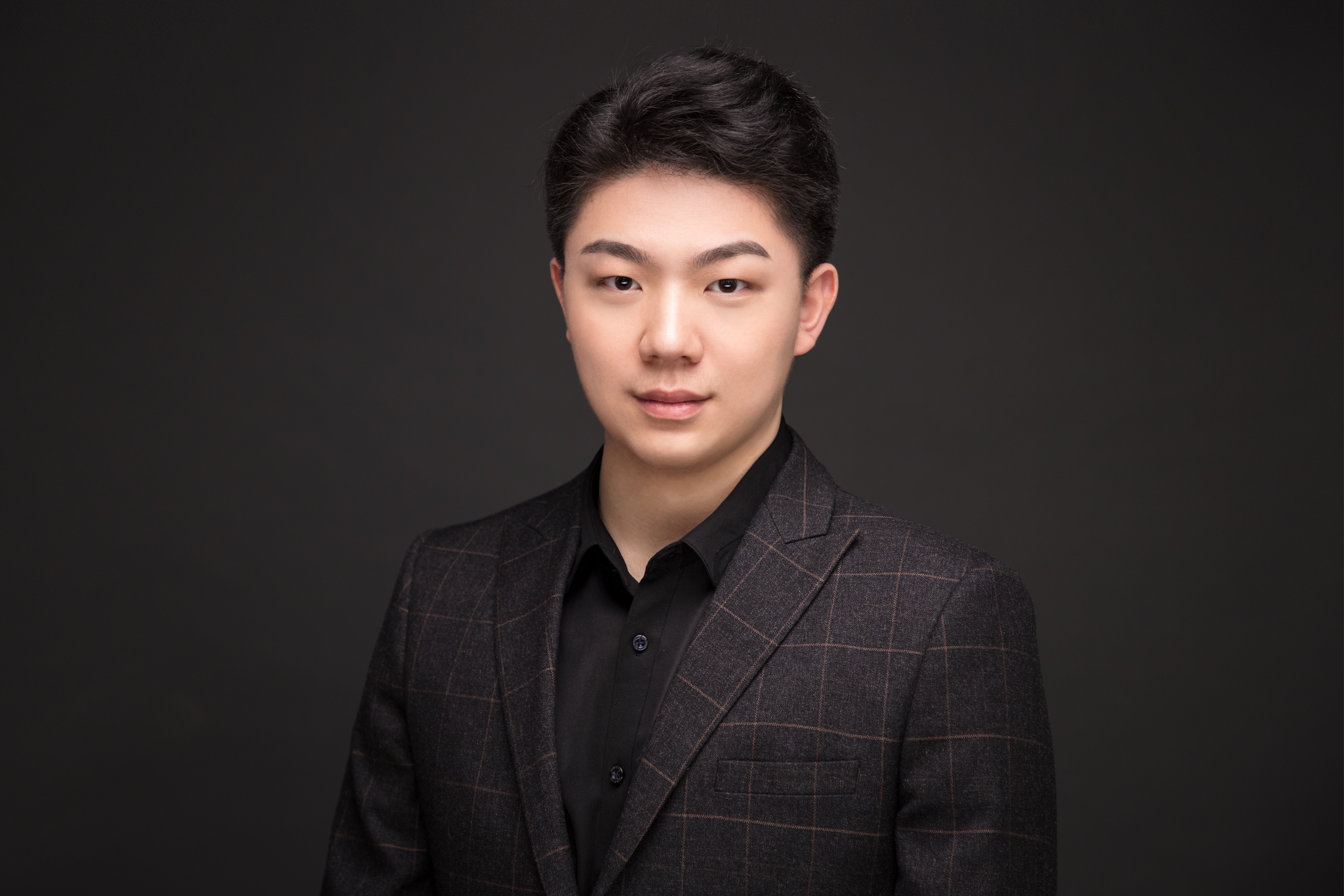
Yiting Liu
Yiting Liu is a Ph.D. student in the Human Factors and Applied Cognition program at North Carolina State University and a researcher in the Translational Vision Research Lab. His work focuses on human factors research and understanding how people interact with systems in real-world settings. In this project, he leads the development and implementation of the study and coordinates participant recruitment and data collection.

Yingchen He, Ph.D.
Dr. Yingchen He is an Assistant Professor in the Human Factors and Applied Cognition program at North Carolina State University and the lead of the Translational Vision Research Lab. As a visual scientist specializing in the intersection of cognitive psychology and human-centric design, Dr. He applies her expertise in sensory perception and vision loss to improve the experience of daily visual tasks, such as reading. As the conceptual lead for Wicked Words, she originated the idea and oversees its strategic direction and progress.