From Our Backyard to Space: How One Brazilian Family Discovered Citizen Science
By
Barbara Alencar Rolim
|
Exploring the world and contributing to global science does not require a professional laboratory or an advanced degree—sometimes, all you need is a backyard, a smartphone and a curious family.
Editor’s note: This guest post was contributed by Bárbara Alencar Rolim, co-founder of Independent Family Scientists (CFI) in Igarassu, Pernambuco, Brazil. It describes her family’s experience discovering citizen science and developing community projects using platforms including SciStarter, iNaturalist, GLOBE Observer and GeoNadir. The views and descriptions of the family’s projects are the author’s own.
Credit: Independent Family Scientists
The Spark of Global Curiosity
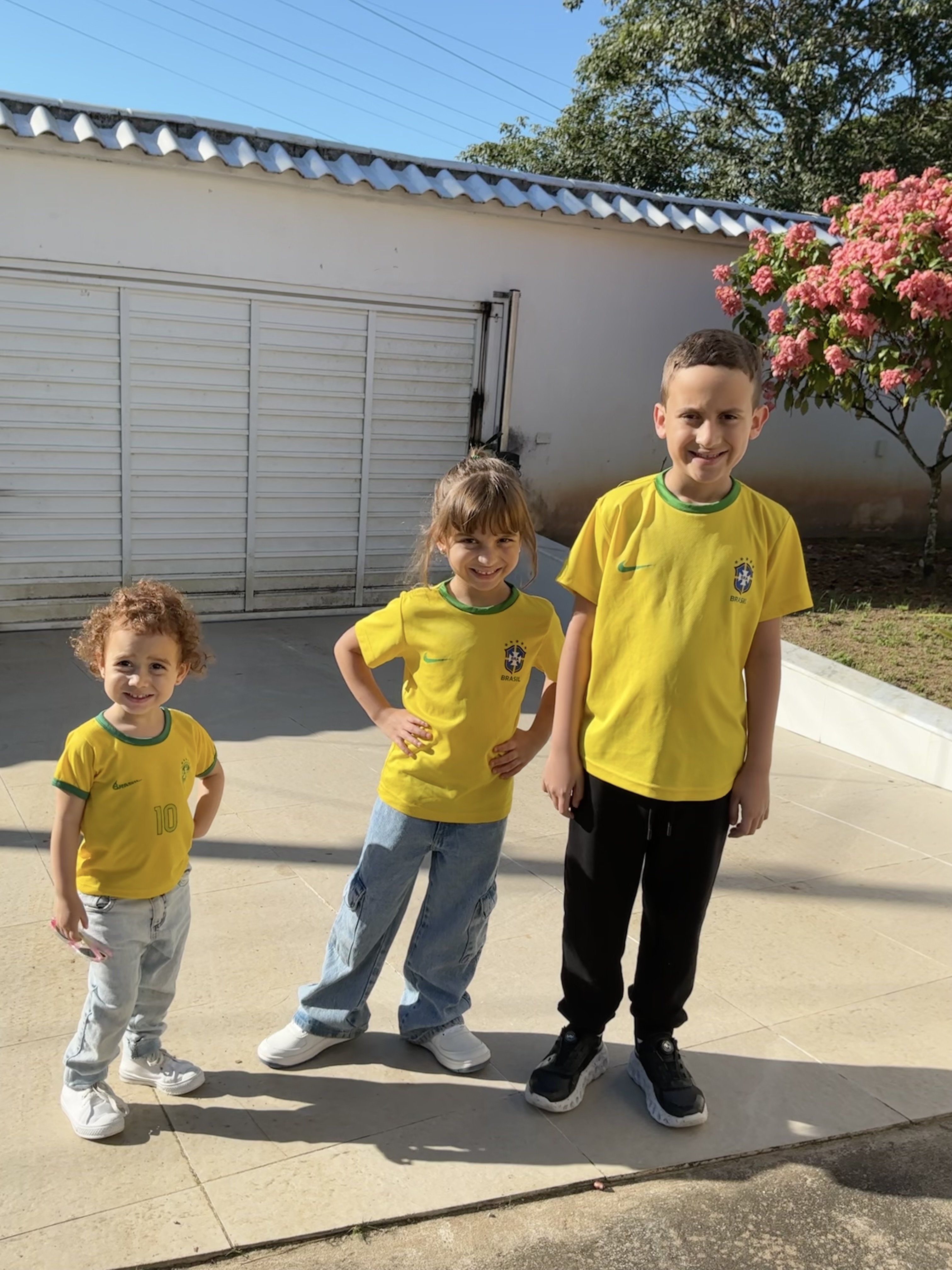
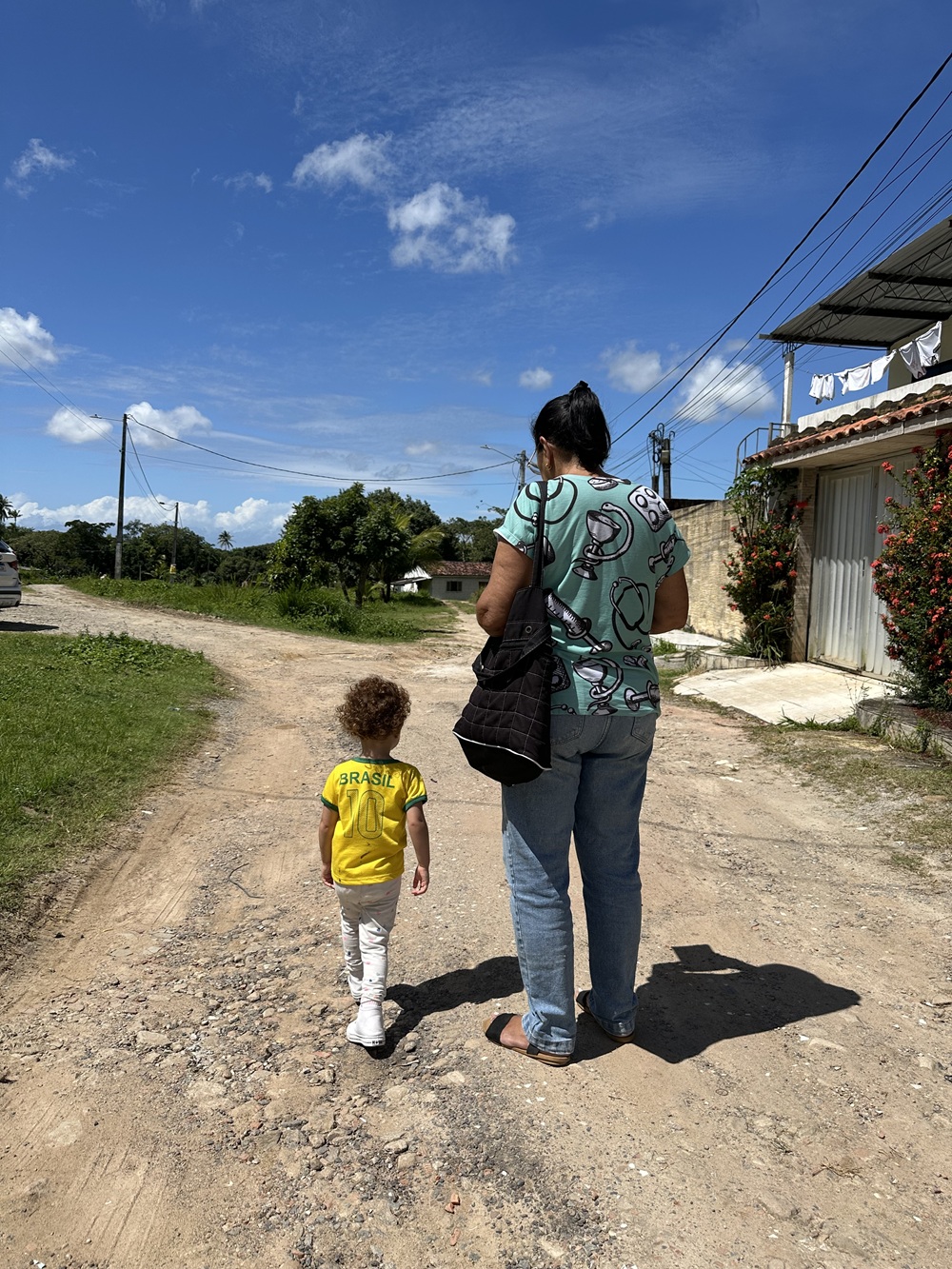
Our family’s citizen science journey began in 2026 in Igarassu, Pernambuco, Brazil, with a smartphone and our own backyard. Our children (Sandeji, Maria Clara, and Emília Valentina) were curious about the world beyond our home, and we began looking for ways they could explore it from where we lived.
…
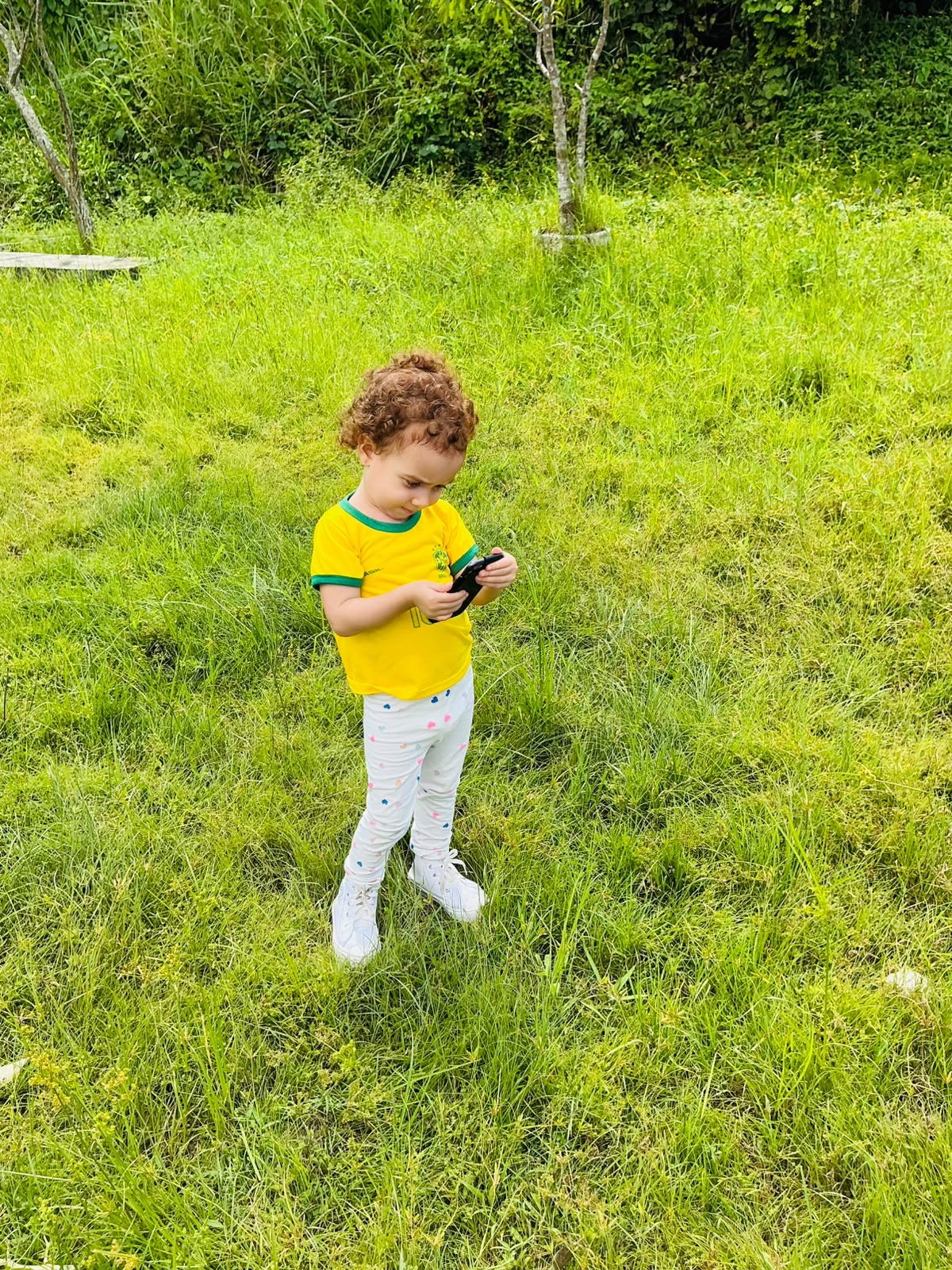
When we discovered iNaturalist, we realized that the plants and animals surrounding us could connect our family to a much larger community of observers and researchers. To our amazement, some of our observations soon reached iNaturalist’s “Research Grade” status, meaning they met the platform’s criteria for verifiable observations with community-supported identifications. Eligible Research Grade observations can be shared with global biodiversity databases and made available to researchers.
“It is so amazing to take photos of plants and insects with a cell phone that it becomes a habit,” says Sandeji, reflecting on his experience as a young volunteer. “We need to tell everyone so they can do it too!”
Credit: Independent Family Scientists
Mapping and Adding a Soundtrack to Science
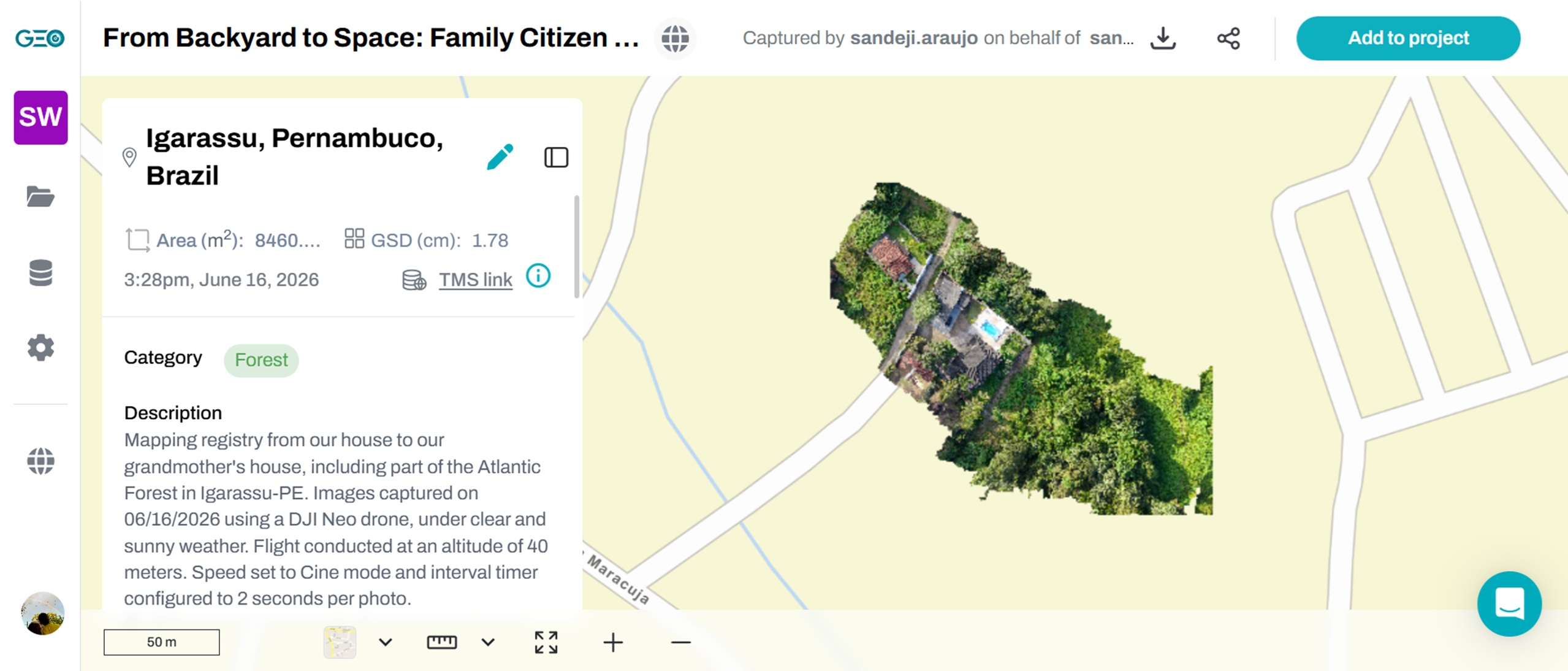
Days later, we decided to combine our family’s passion for drones with aerial photogrammetry. We experimented with creating an aerial map between our home and the children’s grandmother’s home, and began thinking about how other families might adapt a similar approach to exploring their own surroundings.
…
Credit: CFI via GeoNadir
We also began bringing together some of our family’s other interests—music, art, technology and science. Sandeji, who studies at the Conservatório Pernambucano de Música, decided our project needed a soundtrack. Using generative artificial intelligence (AI) for digital design, we displayed our historical timeline and associated it with “Asa Branca” and “Ode to Joy”, performed on the flute by Sandeji and accompanied by his father on the guitar.
We added a dedicated technical paragraph to highlight our deep commitment to Inclusive Design: explaining that our independent design badges were custom-built utilizing exact color spectrums chosen by Sandeji Lorenzo who is colorblind. By reviewing these specific visual assets, he ensures they perfectly match his unique field of vision, performing an active role as a visual interface and accessibility analyst for our community gamification tools. While this calibration specifically reflects his unique field of vision as a user-centered case study, the process highlights the importance of testing gamification assets with the community, paving the way for wider accessibility adaptations.
On June 24, 2026, we submitted our project to SciStarter, securing approval the very next day. Shortly after, we integrated our initiative as an official SciStarter Affiliate project to unify all the collected data.
Reality in the Field: Breaking Cultural Barriers in Our BioBlitz
When it came time to host our Global BioBlitz, we faced a challenge that many citizen scientists encounter: initial community engagement. We promoted the event heavily, both on Instagram and in person. People watched our videos and found everything beautiful, innovative and fascinating, yet it still seemed very difficult to get them to take the next step and participate.
…
Just like we were a short time ago, the local community and people around us lack knowledge about SciStarter, iNaturalist, GLOBE Observer or GeoNadir. Even when they hold mobile devices in their hands, they do not realize the scientific power those tools offer. Facing this cultural barrier—for which we are already designing new educational materials—and with the Global BioBlitz clock ticking, we had no time to lose. Our solution was to lead by example.
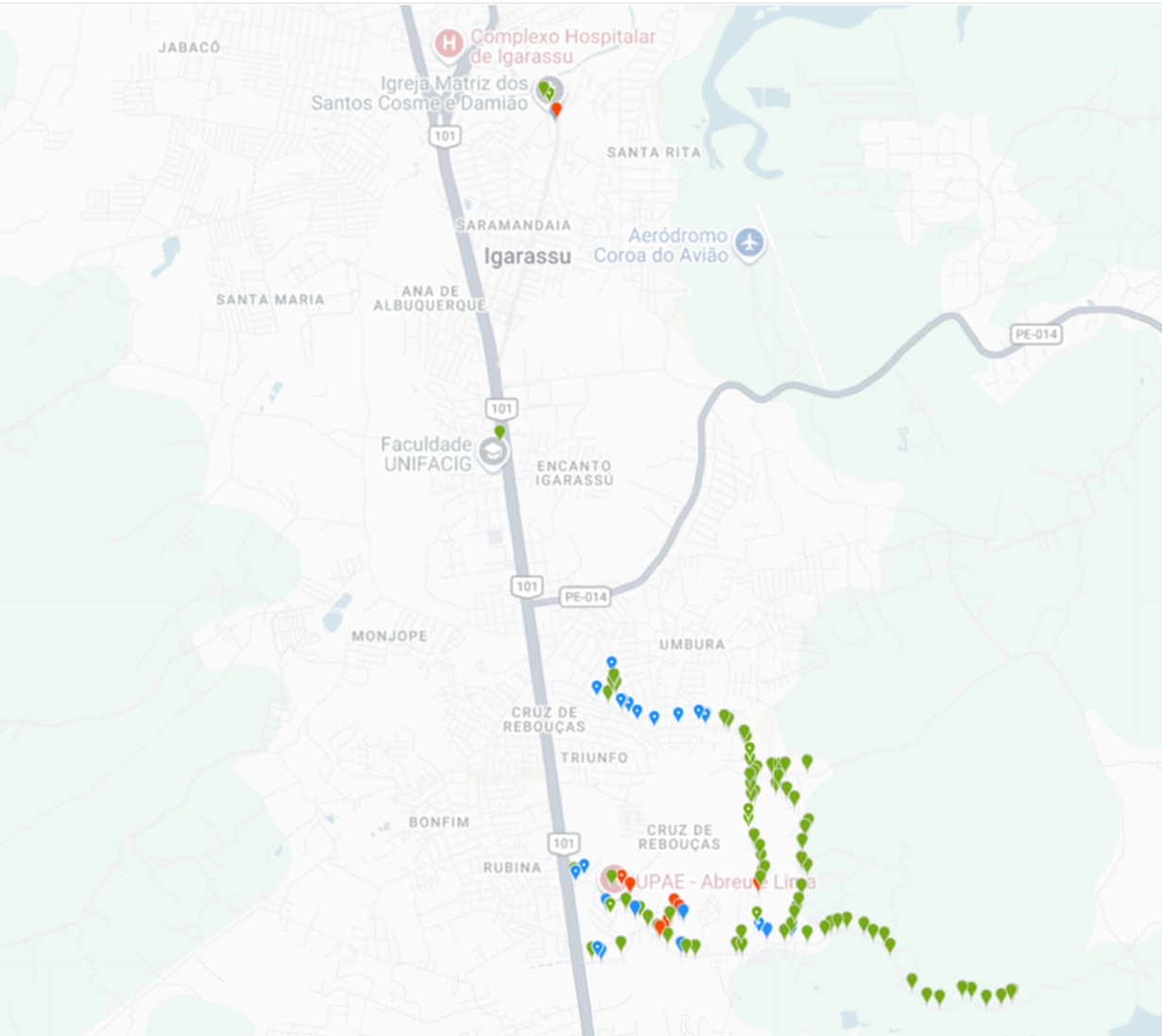
To light up the map of Igarassu, we decided to revisit fantastic locations within our Historic Site. On the first day of the event, it was just us and the children’s grandmother out in the field mapping the surroundings. By the second day, our message began to echo: our team grew as we managed to gather cousins and a dear friend to join our mission.
Credit: CFI via iNaturalist / Google Maps
Together, we walked around mapping and photographing biodiversity near incredible historical landmarks like the Church of Saints Cosmas and Damian (the oldest existing church in Brazil), the Convent of the Sacred Heart of Jesus, the Historical Museum of Igarassu and the Municipal Public Library. Watching the map of Igarassu digitally light up with our footsteps proved to the community just how incredibly easy and accessible it is to participate. It shows that citizen science is with us at all times—we just need to practice it. At the end of the day, looking at that screen filled with new biological milestones, our whole family gathered to celebrate the way we love most: playing music together and celebrating our community victory.
From Backyard Biodiversity to Public Health: The Snail Hunt
As our eyes became trained to observe our surroundings through this family and cultural effort, we realized that our tools could solve an urgent public health issue. In July 2026, our main initiative birthed an invasive-species mapping and community-awareness effort with potential public-health relevance: the Caça-Caramujo (Snail Hunt – Igarassu/PE) project.
…
Credit: Independent Family Scientists
The African Giant Snail (Lissachatina fulica) is an exotic invasive species that causes severe damage to Brazilian biodiversity, local agriculture and public health, as it can transmit serious diseases like meningitis. Through our family collective, Independent Family Scientists (CFI), we launched this campaign on iNaturalist to map these vectors.
When residents find an African giant snail in Igarassu, they take a safe photo without touching the animal and upload it to our project. The family hopes that mapping reports over time could help reveal where the snails are being observed and potentially provide useful information for local awareness and public-health efforts. It bridges the gap between historical heritage, backyards and civic action. Furthermore, our project automatically filters data; any iNaturalist user who records a snail anywhere within Igarassu will automatically pop up on our monitoring map.
How You and Your Community Can Get Involved
To participate in our primary ecological initiative or review our synchronization milestones, you can check the SciStarter Youth Citizen Science Event Page. For ground-level tracking, link your account to your SciStarter profile and log observations via iNaturalist using your own smartphone to earn automatic participation credits. If you visit Igarassu, Pernambuco, you can also join the localized Caça-Caramujo project to help map invasive species safely under adult supervision.
…
For space-level validation, download NASA’s GLOBE Observer app and log in using the exact same email as your SciStarter account (case sensitive). Inside the app settings, connect your observations to SciStarter, head to “Teams” and join our global family team using the Referral Code: GLIDBMRI. You will help international climate scientists calibrate space satellites by logging cloud coverage and measuring tree heights.
Experienced adult drone operators can also explore aerial mapping through platforms such as GeoNadir, following all applicable local aviation regulations and platform guidance.
Call to Action for Libraries and Community Leaders
If you are a librarian, an educator or a community leader, you can support our ongoing environmental and health campaigns by transforming your institution into a local hub for engagement. Libraries—just like the Municipal Public Library of Igarassu we visited—can host orientation sessions and group discussions using our replicable drone guidelines, as well as help families download apps safely using the local internet. The core idea is to empower everyone to use the devices they already have at home, transforming everyday residents into active public health guardians and environmental scientists within their own territory.
🍿🐜 Field Notes – (October 8, 2026): Citizen Scientists Never Take a Day Off
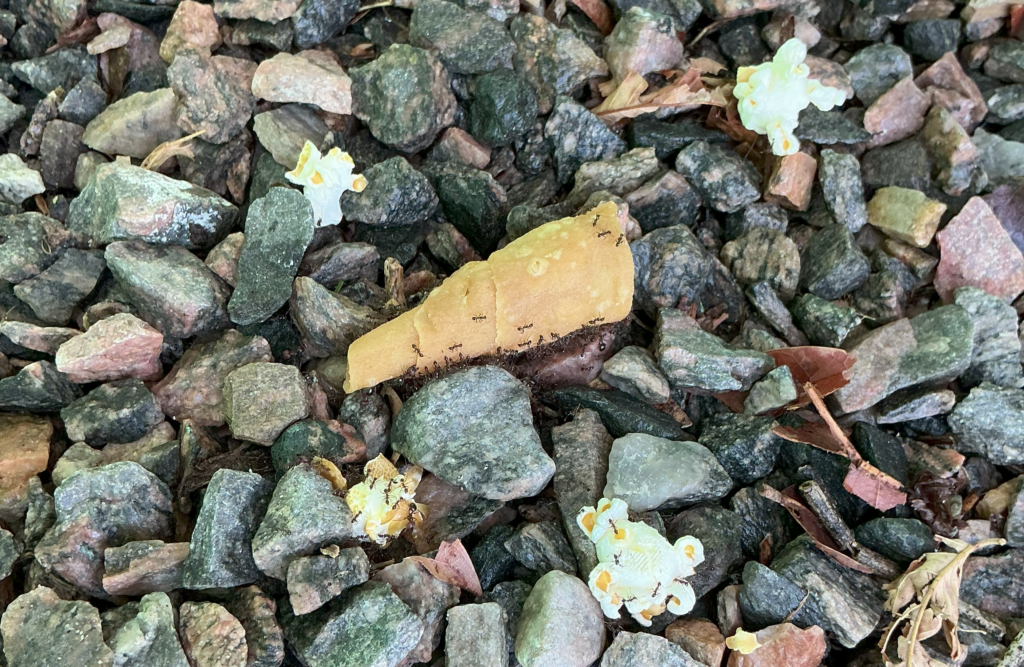
A dropped piece of popcorn and a pastry cone on the gravel ground became the perfect impromptu laboratory for the children to investigate worker ant behavior.
…
Who says science has a schedule? During a relaxed snack break at the Conservatório Pernambucano de Música (CPM), a few pieces of popcorn and a traditional pastry cone (canudinho) fell onto the gravel. It didn’t take long for a bustling delegation of ants to claim the feast. Snack time quickly turned into an open-air laboratory as the children began questioning the insects’ behavior: “Why did they rush over here if popcorn isn’t sweet?”. Eating took a backseat; curiosity won, and they seized the moment to open iNaturalist, document the new visitors, and immediately hunt for more ants around the area. Check out our iNaturalist observations from this day.
It is fascinating how citizen science awakens critical thinking, generates questions about facts, drives people to seek answers, and enriches them with knowledge every single day. That is why we always return to our signature question: “Why isn’t everyone else doing this too?”.
Whether you are a child or an adult, you can experience this as well. Explore one of our pathways, and discover a whole universe of other possibilities across SciStarter.
🗺️ Field Notes – (October 5, 2026): Turning the Commute to School into a Botanical and Aerospace Expedition
How a daily commute to school transformed into a satellite calibration sync and a 200-observation botanical relay mission, led by our children, supported by our youngest, and guided by parental mentorship.
…
🛰️ Backyard Calibration: Perfect Sync with NASA’s Satellite
Our citizen science routine requires constant attention, but it always rewards us by turning our daily life into an adventure. Every day, as soon as Sandeji Lorenzo (8) and Maria Clara (6) wake up, their first task is to open the NASA GLOBE Observer app to check the exact overpass time of the climate monitoring satellites over our region.
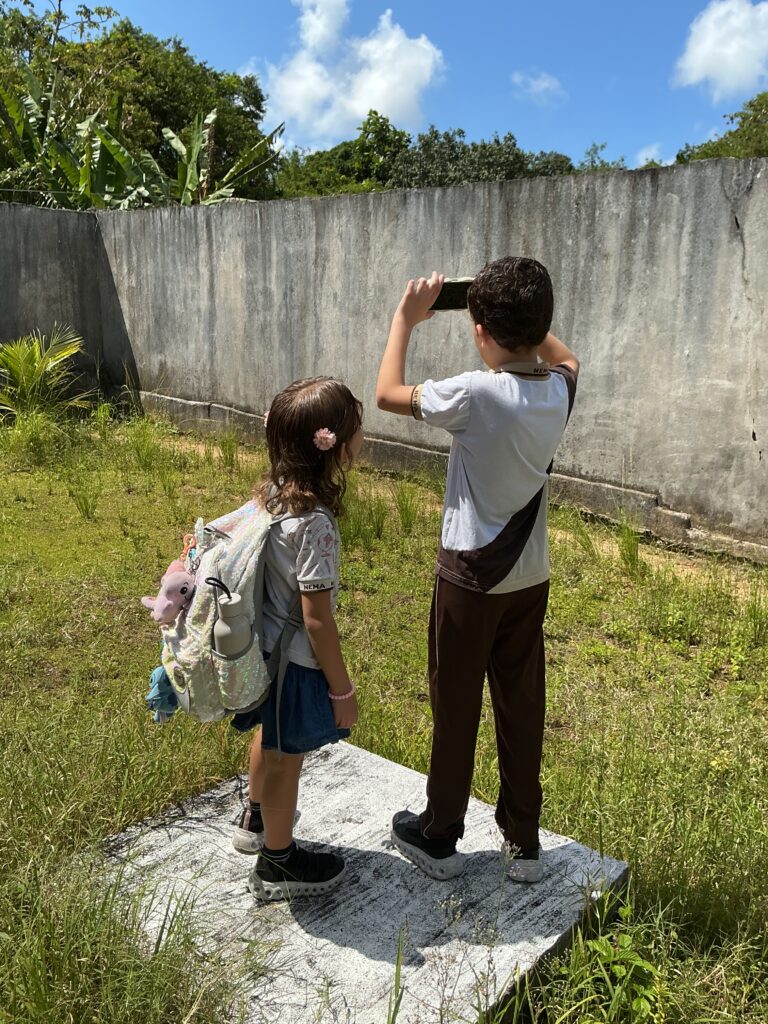
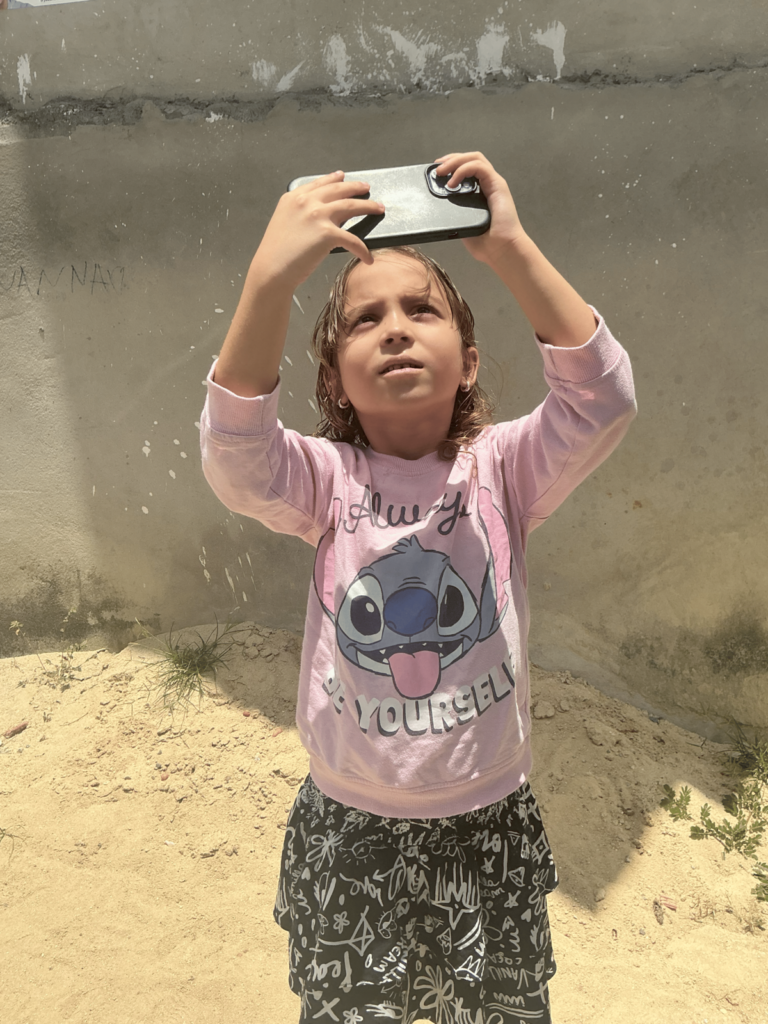
Today, the satellite’s orbital window perfectly aligned with the exact moment they needed to leave for school. Without hesitation, the siblings mobilized in our backyard to perform the calibration: they collected data and took photos of the clouds at the exact moment the satellite passed overhead. With their mission accomplished at home, they headed to school knowing that their local ground-truth data would help NASA scientists validate space readings.
🌿 Observing the Dry Spell: Delegating the Field Mission
The duo’s sharp scientific gaze remained active during the walk. On the way to school, while observing the surrounding vegetation, something caught their attention. Maria Clara noticed the impact of the climate on the flora and turned to her brother: “Look how dry the plants are!”
Knowing they would be in the classroom and wouldn’t have time to photograph everything at that moment, Sandeji Lorenzo demonstrated admirable leadership and a keen sense of scientific collaboration. He affectionately asked their youngest sister, Emília Valentina (2): “On the way back, can you and Mommy record this? So when we return from school, we can start identifying the plants we already recognize to help push the data to Research Grade status!”
📊 The Results: 200 Records and a Team Success
Their strategy worked flawlessly. On the return commute, little Emília participated with incredible enthusiasm and energy by my side, pointing out and cheering at every discovery, while I operated the app to capture the data. Together, we logged approximately200 biodiversity observations along the way! As soon as the older siblings returned from school, the botanical identification work began on iNaturalist, aiming to convert those field observations into valuable data for the scientific community.
At the end of the day, as a mother, I sat down to tell my husband everything that had happened. As a father and an educator, he listened closely and made us reflect deeply on the real pedagogical impact of this experience. We discussed how citizen science truly changes children’s lives: they become genuinely engaged, learn through hands-on practice, delegate complex tasks, assume real responsibilities, and keep their eyes constantly trained on their territory. Thanks to this educational seed, nothing passes unnoticed by them anymore, because they have learned to transform their daily routine into a true real-world scientific mission.
Our family journey proves that citizen science knows no boundaries of age or geography. Anyone—whether a curious child, a young student, or a determined adult—can become a citizen scientist from anywhere in the world. All it takes is a sharp gaze at your surroundings and a desire to make a difference on our planet. To discover how your daily routine can also become a great discovery and to take advantage of everything citizen science has to offer, start right here: SciStarter.
🌍 Field Notes: From the Ballot Box to Global Science – The Election Sunday Challenge! (October 4,2026)
Check official resources for verified information regarding Brazil’s election schedules, but the impact of our actions is global!While millions of citizens exercise their civic duty at the ballot box to shape the country’s future, our community reminds us that each of us can also transform the planet every single day through citizen science.
…
True citizenship knows no borders. Your role at the ballot box helps define your local future, but the scientific data you collect connects your reality directly to international research networks. Anyone, anywhere in the world, can protect the environment using just the smartphone they already have at home.
That is why we are launching the Global Citizenship Challenge! This Sunday, after fulfilling your civic duty, join our mission:
🚀 Choose Your Mission (or do both!):
Space Mission(NASA GLOBE Observer): On your way to your polling place, open the app. In your profile settings, join our official team using the code GLIDBMRI and report the cloud cover from the exact location where you are. Your observations help international climate scientists calibrate space satellites!
Biodiversity Mission(iNaturalist): Photograph and record the wildlife and plants around you (such as native plants or invasive species). Each record feeds into global biodiversity databases used by researchers worldwide.
🗺️ Not in Brazil? Participate from wherever you are!
This challenge has no borders. If you are anywhere else on the planet today, make your records from where you are. Science needs global data, and your contribution is essential.
Whether at the ballot box or in your backyard, your choices matter to the world. Vote consciously and come light up the global science map with us!
Notes from the field – October 2, 2026: 🚨BIG UPDATE
We are thrilled to share that From Backyard to Space has been selected as one of the 80 finalists for the Nexus Rural Prize 2026, an international initiative promoted by the International Fund for Agricultural Development (IFAD/UN) and PROCASUR! Out of projects from 33 countries across Latin America and the Caribbean, our youth-led citizen science initiative from Igarassu, Brazil, stood out. We have earned a spot in an advanced training program for Artificial Intelligence (AI) and Blockchain applied to rural communities. This is a huge milestone where our citizen science data advances to the technological frontier.
Notes from the field – September 24, 2026: A fair trade!
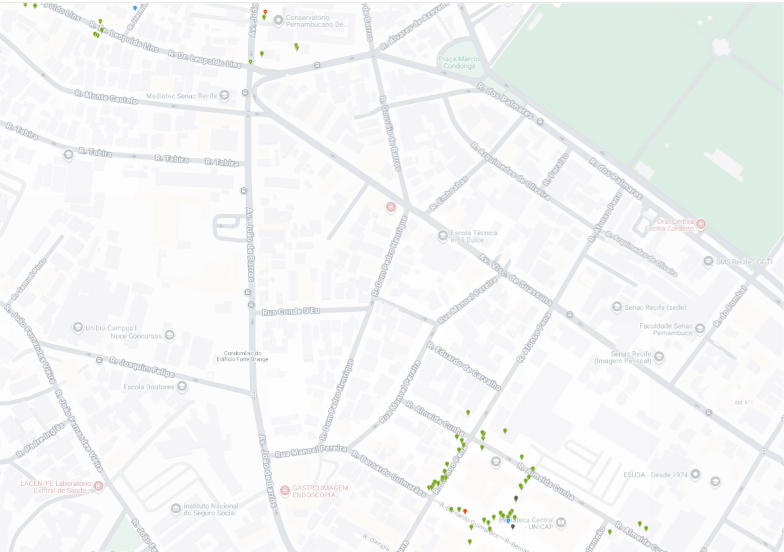
And since this project fits into every moment of our lives, today we traded a waiting moment at the CPM (Conservatório Pernambucano de Música) for an incredible experience. Unlike the days when we explore the woods around where we live, today we were in the city and close to a highly prestigious place: UNICAP (Universidade Católica de Pernambuco).
…
Note: Through the pins of the collections made, it is possible to identify the mentioned locations.
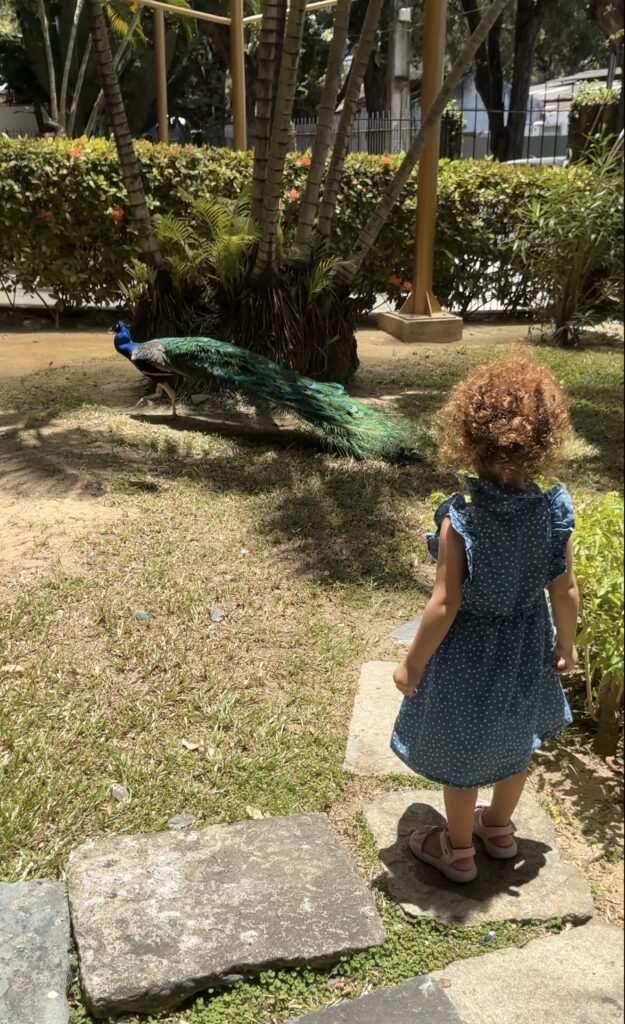
So, without much expectation, we went there to explore the space and register a plant or two that we might find in the garden. But to our surprise, the place is a true paradise of nature! We found a beautiful green area, a pond with geese and fish, as well as pigeons and birdsong that easily stood out from the treetops. To crown the moment, we even had the opportunity to watch a beautiful parade of a peacock that was roaming freely among everyone.
Screenshot
The image above is a screenshot from the video you can watch by clicking here👈
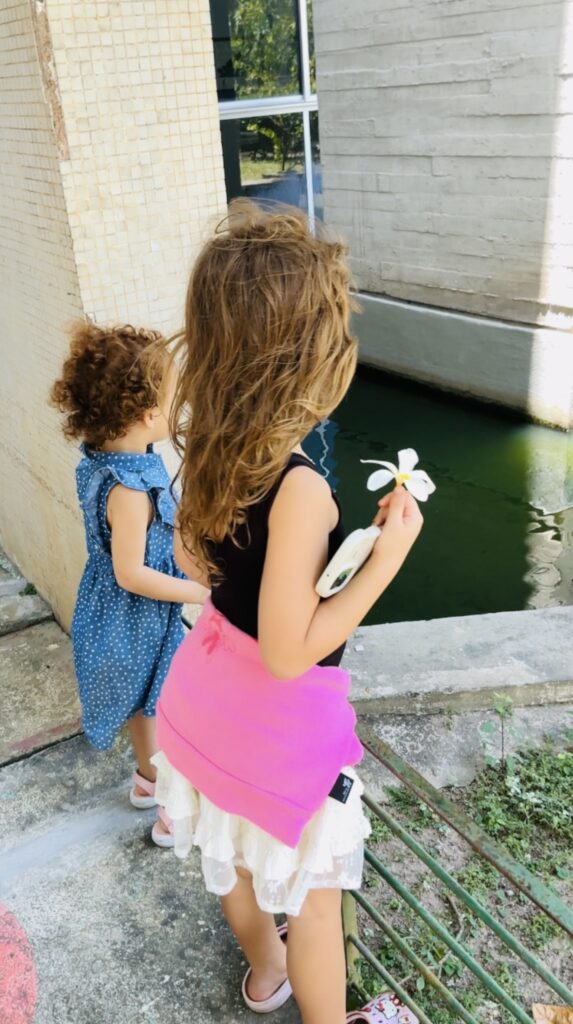
This is not just a beautiful story; it is the real account of yet another enriching experience that this project provides us.
Screenshot
The image above is a screenshot from the video you can watch by clicking here👈
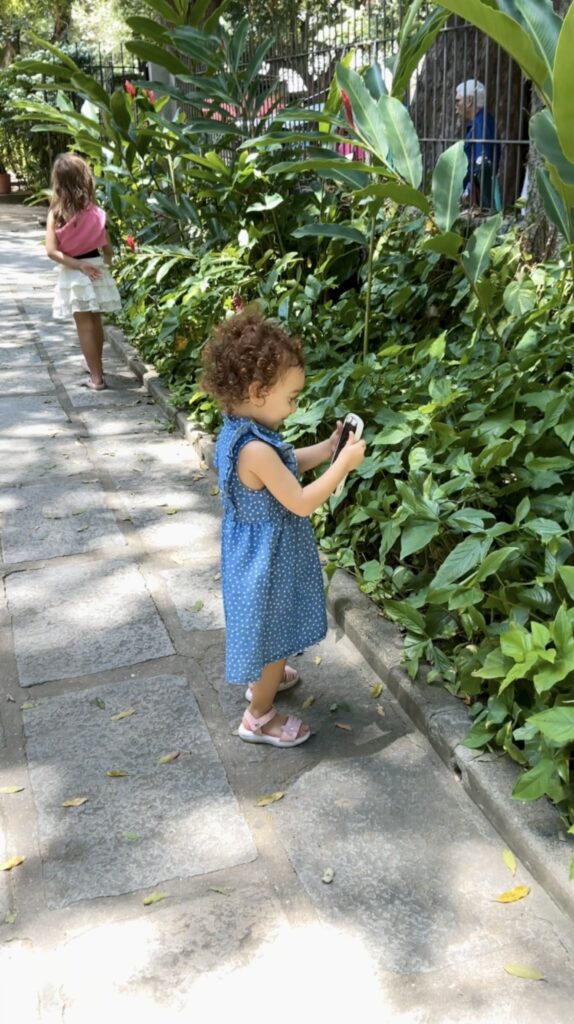
It is fascinating to notice the impact of our example. Today, Emília Valentina, our youngest who actively accompanies us in every registry, surprised us by perfectly imitating the way we make our observations. She still can’t take a perfect photo, but she already understands and absorbs the whole process. Soon, she will be making her own discoveries by herself. It is wonderful to see that respect and care for the environment are already part of what she experiences, naturally, every day.
Screenshot
The image above is a screenshot from the video you can watch by clicking here👈
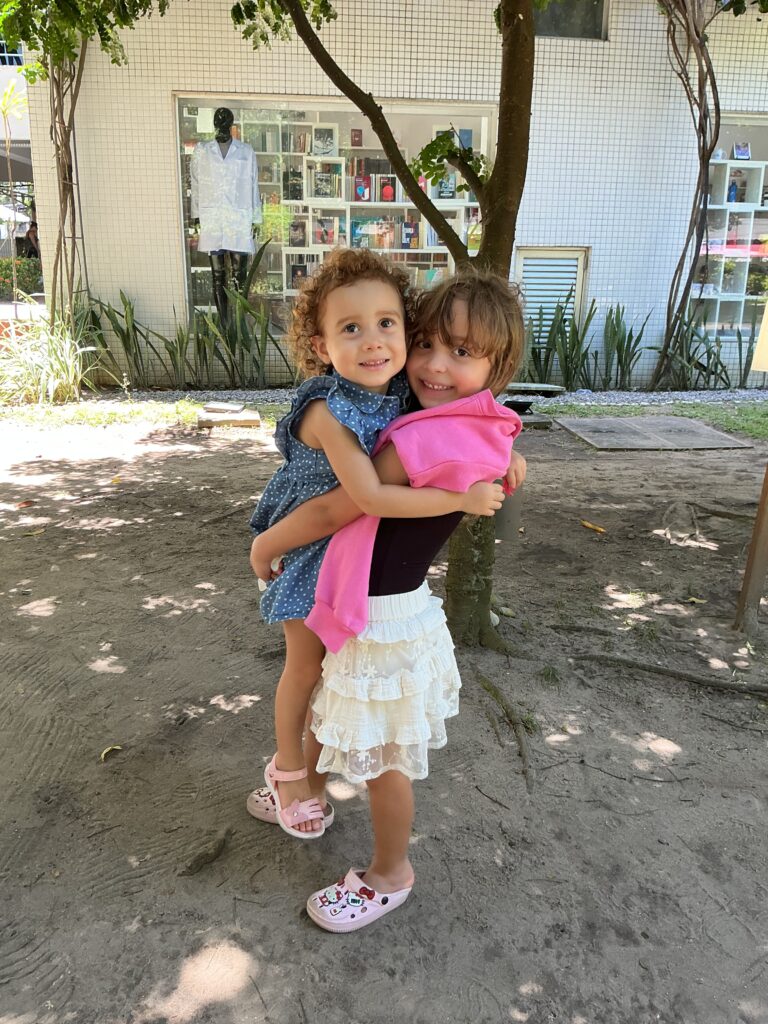
That way, time flies! Maria Clara even tried to carry Emília in her arms just to try and show her things closer up.
And you, have you ever thought about registering a place like this, or is your routine already part of it? This initiative has the power to accompany you and fits perfectly into your own reality. Start right now, from wherever you are, and come map the world with us!
🗺️ Field Notes (September 22, 2026): Unlocking a Hidden Green Zone!
Have you ever discovered a completely untouched natural spot right in your own neighborhood?
…
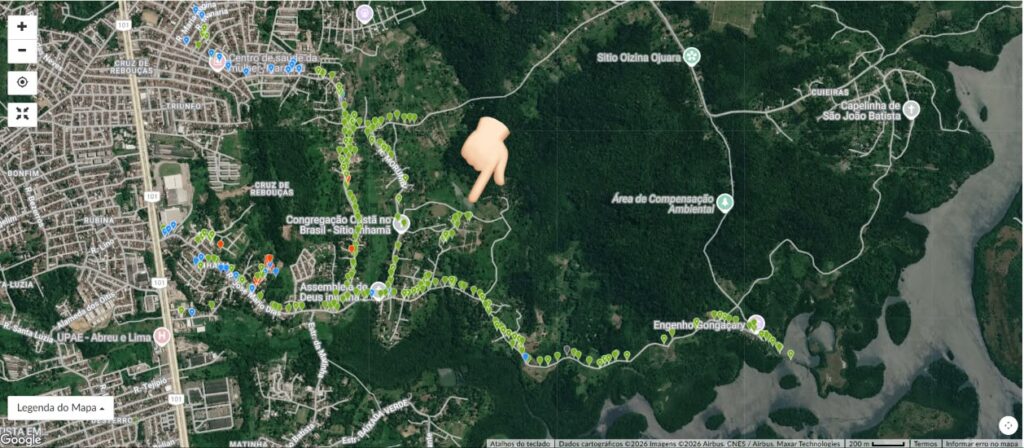
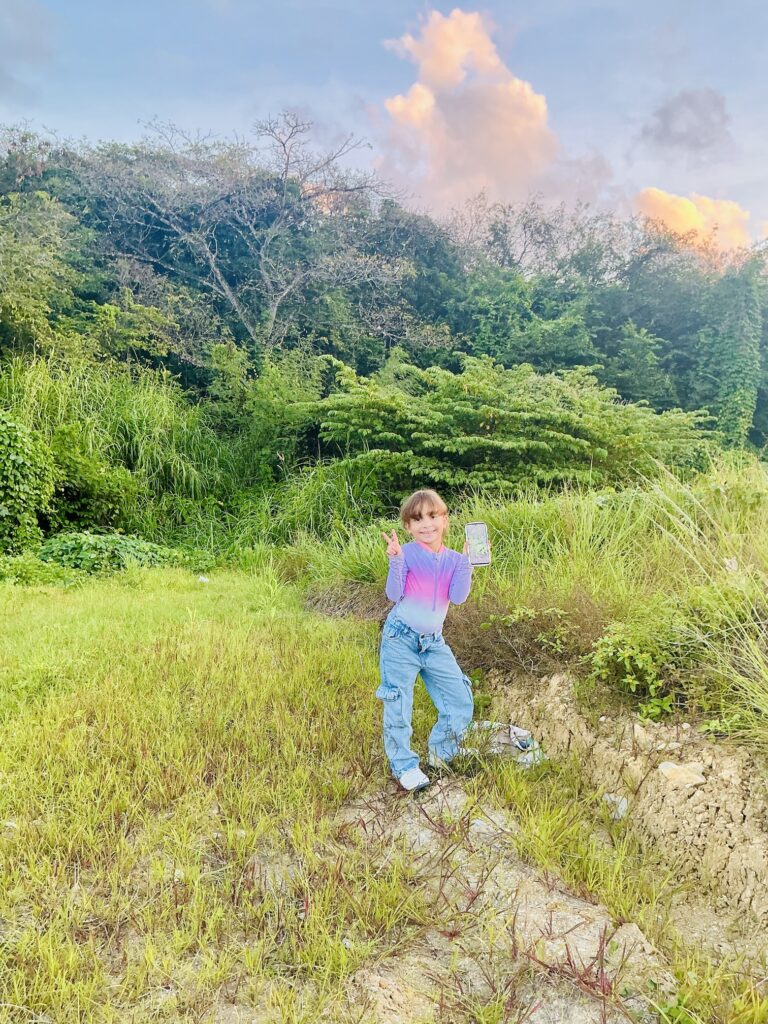
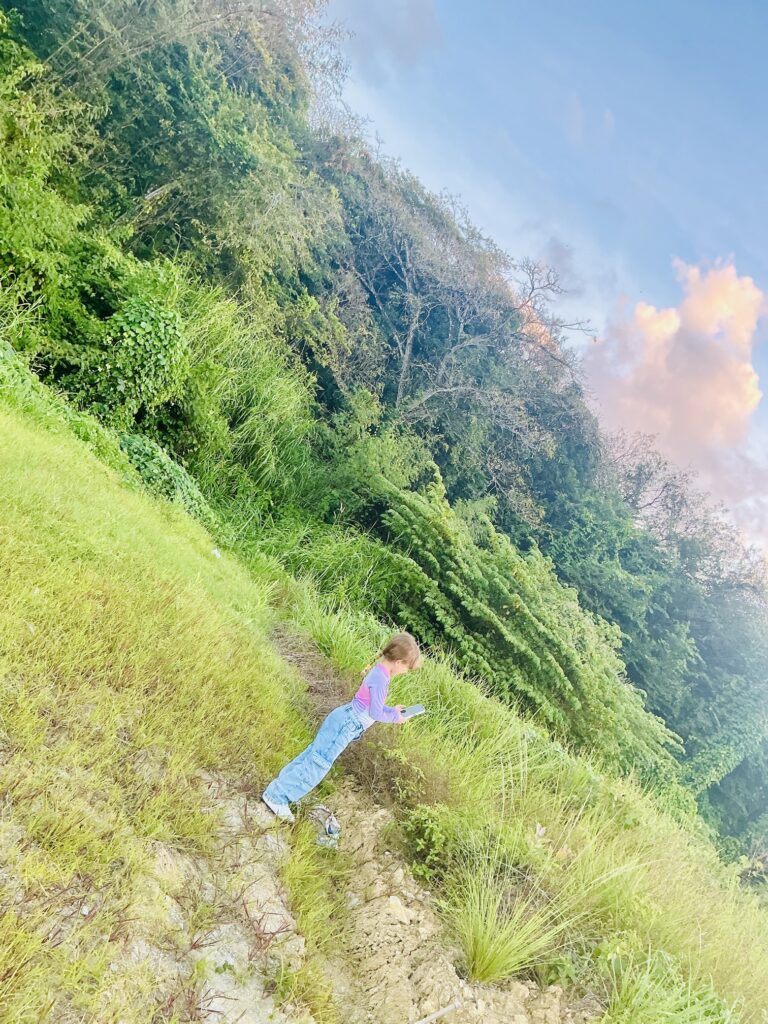
Today, we took advantage of the late afternoon to explore a brand-new area in our surroundings. It is a beautifully secluded location—with just a handful of houses and barely anyone along the way—but it hides an immense, unexplored stretch of dense vegetation perfect for our project!
Getting there safely is always our priority. Because it is too far to walk with the children, and we often encounter stray dogs along the road that might react negatively, we made the quick drive over to establish our base.
As you can see in the attached map above, I have pointed out with a 🖐️ hand emoji exactly where we were today, right next to that massive, dense green zone.
We made our first stop at a specific point to gather observations for iNaturalist and launch a drone flight. We did this because we knew that once we entered the deeper forest area, our current drone (the DJI Neo) would lose connection due to the dense canopy. During a recent visit to the historic Engenho Gongaçary, we experienced a very short flight where the drone completely lost its signal. We thought we might lose it, but thankfully its automatic return-to-home function kicked in and everything ended up fine. However, we couldn’t capture that fantastic historical site from above, much like the deep forest area we explored today.
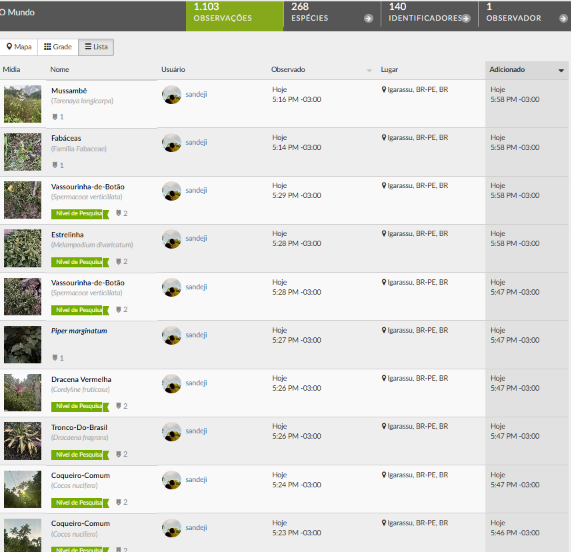
At our second stop, since a drone flight wasn’t technically viable, I recorded a short video with my phone just to give you a sense of the scale of the location. Despite the technical limits, we managed to make nearly 100 observations in about an hour! As soon as we got home, we uploaded the photos and began identifying the flora—some of which we are still learning about, alongside well-known regional species like vassourinha-de-botão (buttonweed), estrelinha (melampodium), coconut trees, banana trees, and guizo-de-cascavel (rattlebox).
We also observed a massive variety of birds. You can clearly hear their songs in the video, though our mobile screens and lenses cannot capture them with enough clarity from a distance.
Specifically today, only Clarinha and I went on the trail. Emília had fallen asleep, Sandeji Lorenzo was down with a cold and feeling indisposed, so their father stayed home to take care of both of them.
Through all of this, we are learning that citizen science is not an obligation; it is a lifestyle that we have fully adopted. It follows us wherever we go, whether in the skies or on earth, and our role is simply to document it. So, the question that surrounds us is: why isn’t everyone else doing this too?
If you haven’t stepped into the world of citizen science yet, this is your sign!Click here to get started right now and become part of this global community.
Notes from the field – September 22, 2026: Our Selection for FEMIC 2026
We are thrilled to share a major milestone for our family project! Our initiative has just been selected for FEMIC 2026 (Feira Mineira de Iniciação Científica) under the “Ideia de Criança” (Child’s Idea) category. Check out our achievement in the list!
…
This achievement belongs to Sandeji and Maria Clara, whose vision sparked this entire journey. We must also highlight Emília Valentina, who, even at just two years old, cannot be left out, as she is always with us actively participating in everything we do. Our children will proudly represent our city, Igarassu, in a virtual presentation showcasing their citizen science journey. We are incredibly proud to carry the SciStarter name with us to the event!
Notes from the field – September 22, 2026: Behind the Scenes
Being pioneers in our region brings some unique and funny cultural challenges! The other day, while we were photographing a bird on the ground, a resident questioned us because they thought we were photographing the cars. Also, since we aren’t always home when the NASA satellite passes, we literally have to pull the car over on the side of the road to make our cloud observations, which leaves locals very confused!
…
To handle this, we politely explain: “We are just taking pictures of the plants, okay?” But our best strategy is letting the children take the lead. They will approach residents and ask, “Excuse me, can I take a picture of your plant?” People are always incredibly kind and instantly say yes to the kids!
Meet the Authors
This article was co-written by the Independent Family Scientists (CFI), led exclusively by our single family innovation collective from Igarassu, Pernambuco, Brazil. Co-founded by Public Relations specialist Bárbara Rolim and her husband Sandeji Barbosa, a state History teacher for over 20 years, and conceptualized by their children Sandeji Lorenzo (8) and Maria Clara (6) with the participation of their youngest toddler Emília Valentina (2) alongside grandmother Eleonora Alencar, a community health agent for over 23 years, the family works entirely together to bridge science, digital art and public health. Certified as Citizen Science Champions, recognized in the National “Espalha” Collection of Culture and Climate, officially integrated into the federal government’s SiBBr BioCollect Platform, the family dedicates their collective journey to proving that anyone can explore and protect the planet utilizing devices they already own. To follow their daily field updates and connect with the project, visit their official Instagram.
SciStarter is the place to find, join, and contribute to science through more than 3,000 formal and informal research projects, events and tools. Our community of citizen science projects enables discovery, organization, and greater participation in science. This is also the place to track your contributions, bookmark things you like, and network with others. Join SciStarter to get started.